How to Make Money from Trading? Can You Earn Money from Trading?
Can you make money from trading? Learn realistic monthly returns, how much capital you need, what Expectancy is, why Win Rate is not everything, and how to start with a real process.
How to Make Money from Trading? Can You Earn Money from Trading? is a strategy playbook on Xcelerate Trade. Read the summary and overview to learn the setup logic, invalidation ideas, and access rules before unlocking premium chapters or scripts.
Strategy content is for education and structured practice. It is not personalized investment advice. Always define stop risk, position size, and market conditions that fit your plan.
Continue with related Indicators and Academy tracks when you need chart tools or foundational lessons. Pricing explains membership tiers and individual unlocks.
When lessons exist, progress through chapters and quizzes in order. When only premium blocks exist, connect a wallet that meets the listed access rule before reading gated material.
Duration: ~22m
Category: strategies
Overview
Capital, Expectancy, risk, and process: how money is made in trading without unrealistic daily-profit promises.
Can you make money from trading? Can you live from trading? How much can you earn per month and how much capital do you need to start?
These are among the most common questions from people discovering financial markets. See also the lesson What is trading and how you can get started.
Online you find videos with thousands of dollars in profit, traders claiming daily income, and strategies sold as paths to financial independence.
But how much of that reflects reality?
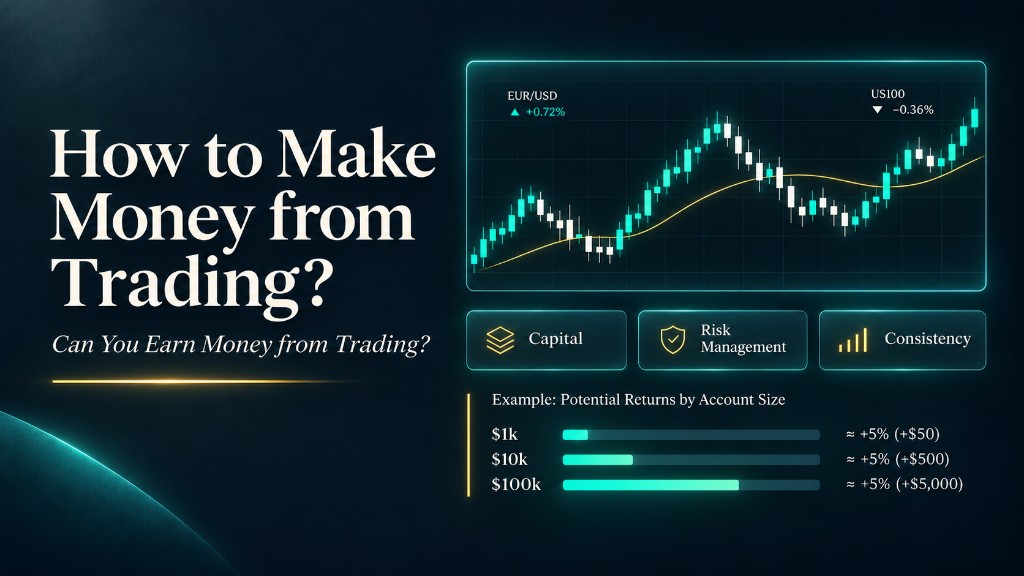
The answer is yes - money can be made from trading. Professional traders, Proprietary Trading firms, and financial institutions run active trading operations.
However, the possibility of profit does not mean most individual traders are profitable. Trading involves significant risk, and many participants lose money - especially when using leverage and trading without a defined process.
To understand how money can be earned from trading, you first need to understand where profit comes from, what drives results, and what separates a trading process from pure speculation. Continue with what trading is if you are still at the fundamentals.
How do you make money from trading?
Trading means buying and selling financial instruments to benefit from price changes.
Those instruments can include:
- Forex, such as EUR/USD or GBP/USD;
- stock indices, such as S&P 500, Nasdaq 100, or DAX;
- gold and silver;
- stocks;
- cryptocurrencies;
- other financial instruments.
A trader may seek profit when price rises (Long) or when price falls (Short), if the instrument allows that type of trading.
For example, if a trader buys at 100 and sells at 105, the price difference favours the position. Actual profit still depends on position size, instrument type, and trading costs.
If the market moves the other way, the trader can lose. That is the first thing to understand: every profit opportunity also carries risk. See also Risk Management, Win Rate, and the power of probabilities.
Can you really make money from trading?
Yes - but there is an important difference between making money on a few trades and being profitable over the long term.
Anyone can have a winning trade. A trader can buy gold, price can rise, and the trade can close in profit. That does not prove a profitable strategy.
To assess profitability you must analyse results over a sufficiently large number of trades.
A sustainable trading process should account for:
- Win Rate;
- Average Win;
- Average Loss;
- Risk-to-Reward Ratio;
- Expectancy;
- Maximum Drawdown;
- trading costs;
- execution consistency.
A few winning trades may reflect a good strategy - or luck. The difference becomes clearer with data. See Profitable Day Trading Strategy.
Do you need to win most trades to make money?
No.
One of the most common misconceptions is that a profitable trader must win 80% or 90% of trades.
Consider two hypothetical examples.
Strategy A: 40% Win Rate
The trader wins on average 2R when the trade is profitable and loses 1R when it loses.
From 10 trades:
- 4 winners × 2R = +8R
- 6 losers × 1R = −6R
Total: +2R. Even losing 60% of trades, the result is positive.
Strategy B: 70% Win Rate
The trader wins on average 0.5R and loses 1.5R.
From 10 trades:
- 7 winners × 0.5R = +3.5R
- 3 losers × 1.5R = −4.5R
Total: −1R. Despite winning 70% of trades, the result is negative.
These examples show why Win Rate must not be analysed apart from the size of wins and losses.
What is Expectancy and why does it matter?
Expectancy is the estimated average outcome of a strategy based on win probability and the average size of wins and losses.
The formula is:
Expectancy = (Win Rate × Average Win) − (Loss Rate × Average Loss)
For Strategy A: (0.40 × 2R) − (0.60 × 1R) = +0.20R per trade.
That means the strategy has positive expected value under the assumed statistics. It does not mean every trade produces +0.20R.
Individual outcomes stay uncertain, and costs and changing market conditions can affect real profitability. For measurement on historical data, see Backtesting and Forward Testing.
How much can you earn from trading per month?
This is probably the question beginners care about most.
The answer depends on capital, strategy, market conditions, costs, and risk taken.
Suppose a trader achieves a hypothetical 2% return in one month:
- $1,000 → $20
- $5,000 → $100
- $10,000 → $200
- $50,000 → $1,000
- $100,000 → $2,000
These are mathematical examples only - not estimated or promised returns. A trader can have profitable months, flat months, and losing months.
Capital size affects the absolute value of results. The same percentage return produces very different dollar amounts on different account sizes.
Can you make $100 a day from trading?
It is possible to make $100 profit in a single trading day.
But making $100 once is not the same as earning $100 every day consistently.
Markets do not offer identical conditions daily. Some days have more valid setups; some days have none. Even a tested strategy can produce losses in certain sessions.
If a trader sets a mandatory $100 daily target, they may force trades when the market offers no setup that fits the strategy.
A healthier approach is to evaluate results over series of trades and long enough periods - not to impose a fixed profit for every day.
How much money do you need to start trading?
You do not need tens of thousands of dollars to start learning trading.
You can study markets, use TradingView, run Backtesting, and practise in a Demo account without risking real capital.
For live trading, required capital depends on instrument, broker, leverage, minimum position size, and strategy.
Still, a small account can create psychological pressure. With $500 and a goal of $1,000 per month, expectations are out of line with capital.
Trying to compensate with very high leverage or oversized positions can lead quickly to large losses.
Small capital is not a problem for learning. It becomes a problem when the trader expects unrealistic income from it. See how to learn trading from scratch.
Can you trade with a company’s capital?
Yes. Prop Firms offer evaluation programmes for traders who want access to funded accounts.
In many retail Prop programmes you pay an evaluation fee, hit defined objectives, and stay within risk limits.
If you meet the conditions, you may become eligible for a funded account and payouts under the contract.
A funded account does not always mean the full nominal capital is executed directly in the market. Some firms use simulated accounts; structures differ by company.
Prop Trading does not remove the trader’s financial risk - fees and costs can be lost. But it can be an option for those who already have a tested strategy and can follow strict Risk Management rules.
Dedicated guide: how to get a funded trading account.
What is a profitable trading strategy?
A profitable strategy is not one that wins every trade.
It is a strategy that, after enough trades and costs, shows a positive statistical edge under the conditions where it was tested.
To be evaluated, a strategy needs clear rules. A framework can look like this:
Filters → Confirmations → Execution → Risk Management → Trade Management → Review
- Filters define whether conditions are suitable.
- Confirmations identify the setup.
- Execution defines Entry and invalidation.
- Risk Management controls exposure.
- Trade Management defines how the position is managed.
- Review evaluates results and rule compliance.
Without these components, it is hard to separate a strategy from discretionary decisions. Details: Profitable Day Trading Strategy.
How do you check whether a strategy can produce profit?
Through Backtesting and Forward Testing.
Backtesting applies the same rules to historical data and records every valid setup. The goal is not a few cherry-picked winners - it is measuring strategy behaviour across different market conditions.
For example, a strategy may perform well in a trending market but lose repeatedly in a range. Testing reveals that and lets you calculate Expectancy, Win Rate, Profit Factor, and Maximum Drawdown.
Forward Testing then observes the strategy in live conditions, initially without real financial risk (Demo).
Neither Backtesting nor Forward Testing guarantees future results, but both are essential for evaluating a strategy.
Why do so many traders lose money?
There are many reasons. Some start without understanding the market. Others use excessive leverage or risk too much on one trade. Many change strategy after a few losses, follow signals from the internet, or try to recover losses quickly.
Common problems include:
- Overtrading;
- Revenge Trading;
- FOMO;
- no Stop Loss;
- Position Size too large;
- no Backtesting;
- not following the strategy;
- unrealistic profit expectations.
These behaviours can hurt even a strategy that showed a statistical edge in historical tests.
Trading is not only finding opportunities. It is following a process when results are unfavourable - including Risk Management and psychological discipline.
Can you live only from trading?
Yes - some people earn their income from trading.
That does not mean trading is a stable or predictable income source.
A salary is usually relatively predictable. Trading income can vary a lot: one profitable month may be followed by two negative months.
Withdrawals for living expenses also reduce capital available for trading.
If the goal is to live from trading, analyse not only average results but variability, Drawdown periods, costs, taxes, and the need for a separate financial reserve.
Turning trading into a primary activity before documented results over a long enough period can add financial and psychological pressure.
Is trading a get-rich-quick method?
Trading is sometimes presented as a way to turn a small account into wealth quickly.
Very high returns over a short period often involve extremely high risk.
A trader can double an account with one oversized position - but the same exposure can produce devastating losses.
One trade’s outcome does not prove a sustainable strategy.
In trading, the goal should not be the largest possible profit on the next trade. It should be building a process you can execute and evaluate repeatedly with controlled risk.
How to start trading from scratch
If you have no experience, the first step is not depositing money at a broker.
Start by understanding how financial markets work. Learn the difference between Forex, indices, stocks, and commodities.
Then study TradingView, MetaTrader 5, and the tools needed for analysis and execution.
Then study Risk Management, Market Structure, Liquidity, and technical analysis.
After those foundations, you can learn a strategy with clear rules. Next: Backtesting. Then Forward Testing and execution on Demo to spot implementation issues.
Only when you have enough data and can follow the process does it make sense to evaluate real capital or a Prop Firm Challenge.
Full path: how and where to learn trading from scratch.
Learn how trading works with Xcelerate Trade Academy
If you want to learn trading from zero, follow a structured educational path - not profit promises from day one.
Xcelerate Trade Academy connects market fundamentals with analysis, strategy, execution, and performance review.
The Academy includes 10 chapters, about 70 lessons, and roughly 27 hours and 30 minutes of educational material.
The path covers trading fundamentals, macroeconomics, TradingView and MetaTrader 5, Risk Management, Trading Psychology, Market Structure, Liquidity, technical analysis, Backtesting, and performance evaluation.
The Xcelerate Trade Day Trading strategy is also presented - built on filters, confirmations, and clear execution rules.
It has been analysed on more than 1,000 trades and over 10 years of market data.
That does not guarantee future profitability. The purpose of testing is to understand statistical behaviour and the conditions under which the strategy was evaluated.
To understand how trading works and how a full process is built, explore Xcelerate Trade Academy.
Frequently asked questions about trading income
Can you make money from trading?
Yes. Trading can produce profit, but capital loss is always possible. Long-term profitability depends on strategy, Risk Management, costs, and consistent execution.
How much does a trader earn per month?
There is no standard monthly income. Results vary with capital, strategy, market conditions, and risk. Some traders profit; others lose.
Can you trade with $100?
Some platforms allow small accounts, but instruments and minimum sizes differ. Small capital suits learning and testing more than significant income expectations.
Can you make money from trading without experience?
You can have winning trades without experience, but that does not prove a profitable process. Education, practice, and risk control matter before real financial risk.
Can you make money from trading without your own capital?
Prop Trading programmes can offer funded access after evaluation. They may involve fees and strict rules; funding models differ between firms. See how to get a funded account.
Is trading more profitable than investing?
There is no universal answer. Trading and investing use different time horizons, methods, and risk profiles. Neither guarantees positive results.
How long does it take to become profitable in trading?
There is no guaranteed timeline. Fundamentals can be learned relatively quickly; developing, testing, and executing a strategy consistently takes much longer. Some participants never become profitable.
What is the best strategy to make money from trading?
There is no universal strategy. It needs clear rules, controlled risk, statistically evaluated results, and execution the trader can repeat. See how to validate a profitable strategy.
Trading offers the possibility of profit, but not certainty.
The difference between one winning trade and a profitable trading process shows over time - through data, Risk Management, and consistent execution.
Before asking how much you can earn from trading, understand what you need to learn, how to test a strategy, and what risk you can afford to take.
Continue in Playbooks
- What Is Trading - foundational article for beginners
- How to Learn Trading from Scratch - education and learning path
- Profitable Day Trading Strategy - Backtesting and statistics
- How to Get a Funded Trading Account - Prop Firms and capital access
- Xcelerate Trade Academy - shared educational destination