How to Trade with a Company’s Capital: Getting a Funded Account
Want a funded trading account? Learn what a Prop Firm is, how Challenges work, how to prepare with Risk Management and Backtesting, and how to get trading funding.
How to Trade with a Company’s Capital: Getting a Funded Account is a strategy playbook on Xcelerate Trade. Read the summary and overview to learn the setup logic, invalidation ideas, and access rules before unlocking premium chapters or scripts.
Strategy content is for education and structured practice. It is not personalized investment advice. Always define stop risk, position size, and market conditions that fit your plan.
Continue with related Indicators and Academy tracks when you need chart tools or foundational lessons. Pricing explains membership tiers and individual $XLR unlocks.
When lessons exist, progress through chapters and quizzes in order. When only premium blocks exist, connect a wallet that meets the listed access rule before reading gated material.
Duration: ~14m
Category: strategies
Overview
How to get a funded trading account: Prop Firm, Challenge, Risk Management, Demo, Backtesting, and the right order before funding.
One of the biggest problems for a beginner trader is capital.
You can learn to analyse the market, build a strategy, and get consistent Backtesting results — but trading a large enough personal account still requires capital.
There is another option: Prop Trading.
Instead of trading only your own money, you can try to access a funded trading account through a Prop Firm.
To get there, you must show that you can follow trading and Risk Management rules.
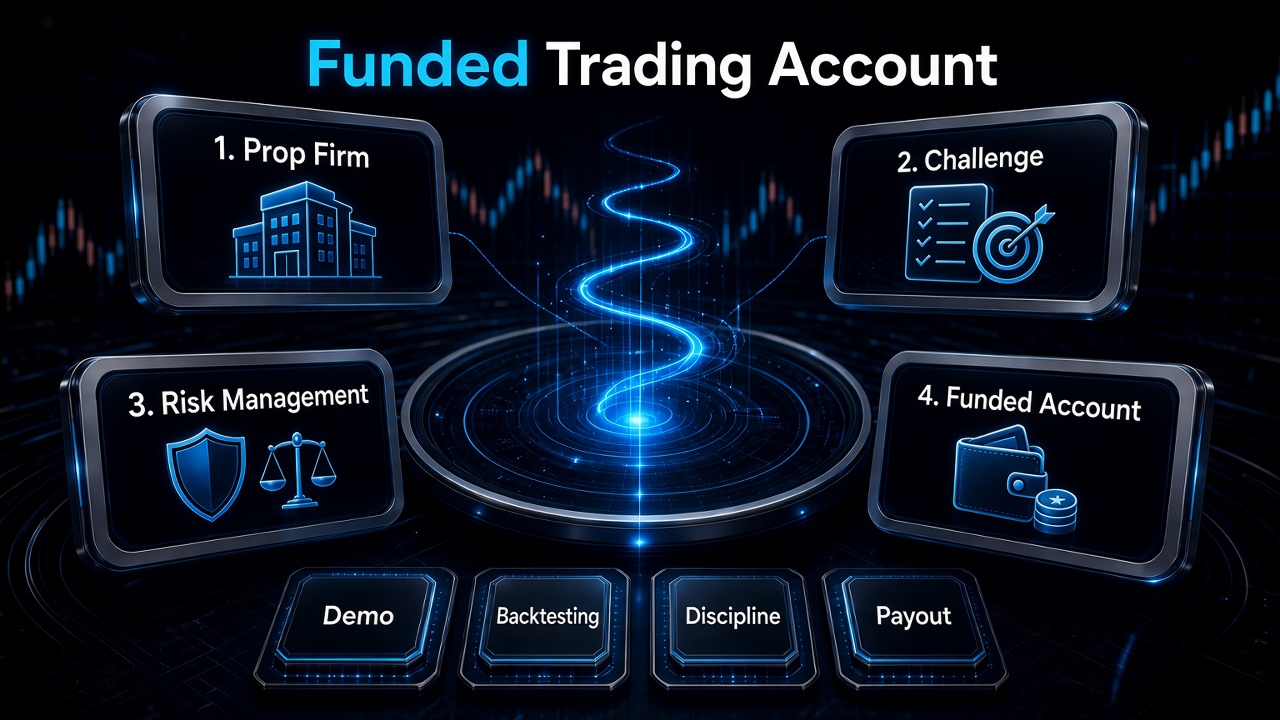
What is a Prop Firm?
Prop Firm stands for Proprietary Trading Firm.
In modern retail Prop Trading, firms offer evaluation programmes where traders prove they can trade within defined targets and risk limits.
You usually choose a programme size and start an evaluation, often called a Challenge. There is typically a fee.
If you meet the rules without breaching risk limits, you may become eligible for the firm’s funded stage.
Exact models differ — always read the rules before buying a Challenge.
What is a Funded Account?
A Funded Account is the stage after evaluation where you trade under the Prop Firm’s conditions and may receive a share of eligible profits.
“Funded” does not necessarily mean the displayed sum is deposited into your personal account or that every trade is executed in the market with the full nominal capital.
Account structure, execution, and payout terms vary. What matters for you are programme rules, risk limits, payout conditions, and how the firm defines the funded stage.
How do you get funding for trading?
Details differ by firm, but the general path is simple.
1. Learn to trade first
A Prop Firm Challenge should not be where you learn by trial and error. Before paying for an evaluation, understand at least Market Structure, Risk Management, Position Sizing, Stop Loss, Take Profit, Risk-to-Reward, Drawdown, your strategy rules, and platform execution.
Without a defined, tested strategy, a Challenge becomes a paid experiment. See also how to learn trading from scratch.
2. Build and test a strategy
Before Prop Trading, know exactly what you will execute: filters, confirmations, Entry, invalidation, Stop Loss, Take Profit, risk per trade, and when you do not trade.
Backtesting shows historical behaviour: Win Rate, Average Win/Loss, R:R, Expectancy, and Drawdown.
Without that data, it is hard to know if your strategy fits Prop Firm rules. See Profitable Day Trading Strategy.
3. Learn to control risk
For Prop Firm traders, Risk Management is critical. Hitting a Profit Target is not enough — you must do it without breaking programme limits.
Depending on the firm, rules may cover Maximum Daily Loss, Maximum Loss, Drawdown, position size, news trading, overnight/weekend holds, minimum trading days, and consistency.
Rules change over time. Always read the current terms on the Prop Firm’s site before you start.
What is a Prop Firm Challenge?
The Challenge is how the company evaluates you — for example reaching a Profit Target without breaching Daily Loss or Maximum Loss.
Some programmes have one stage; others have two or more before funded eligibility.
The goal should not be finishing as fast as possible. Forcing extra trades to finish sooner can destroy the process you are trying to prove.
A simple example
Suppose your strategy risks 0.5% per trade and you get three valid setups in a week: −1R, +2R, +2R → +3R.
You did not need ten trades a day or oversized risk. You followed the same rules and let the statistical edge work across a series of trades — closer to real Prop Trading than trying to “pass” with one huge trade.
Why do traders fail Challenges?
Often the market is not the problem — the reaction to evaluation is. Profit Targets create pressure to trade. Daily Loss limits create emotion after a loss. Then comes Revenge Trading or taking setups you would normally skip.
A Challenge tests process discipline as much as Entry skill.
Do not reinvent the strategy every day
A common mistake is changing the strategy during evaluation: add an indicator, change timeframe, move the stop, chase another method. Then there is no process left to measure.
If you tested the strategy before the Challenge, your job is to execute qualifying setups — not reinvent rules after every result.
A funded account is not zero risk
“Trading with company money” does not mean you have nothing to lose. Challenges have fees; breaking rules can end the evaluation or funded access. Repeated Challenges without a validated process get expensive.
Prop Trading does not remove Risk Management — it makes it more important.
How do you choose a Prop Firm?
Do not look only at the account size on the homepage. Check Daily/Maximum Loss, Drawdown calculation, Profit Target, news rules, overnight/weekend rules, instruments, platforms, payout terms, Profit Split, fees, strategy restrictions, and funded account terms.
Review company history and official docs before you pay.
What strategy fits a Prop Firm?
There is no single “Prop Firm strategy”. It must fit the programme limits. If your strategy can produce five or six losses in a row, size risk so that series does not automatically breach Maximum Loss.
Backtesting data becomes part of Risk Management. See how to validate a profitable strategy.
Demo → Backtesting → Challenge → Funded
Order matters: Education → Demo → Strategy → Backtesting → Forward Testing → Consistency → Prop Firm Challenge → Funded Account.
Not: Challenge → loss → another Challenge → new strategy → another Challenge.
Build the process before you hunt for capital.
Can you Day Trade a funded account?
Yes. Day Trading is common in Prop programmes when firm rules allow it. Still check news rules, Drawdown, instruments, and session hours. Strategy should drive trades — not the Profit Target.
How to prepare for a funded account
Before buying a Challenge, simulate the exact rules on a Demo: same virtual capital, Daily Loss, Maximum Loss, Profit Target, and trading rules. If you cannot follow them in simulation, paying a fee will not fix it.
Learn trading before you seek funding
Capital does not replace education. Before a Prop Firm you need markets, Risk Management, Market Structure, Liquidity, execution, and strategy.
Xcelerate Trade Academy covers that path: ~10 chapters, ~70 lessons, ~27h30m, including the Xcelerate Trade Day Trading methodology analysed on 1,000+ trades and 10+ years of market data.
Larger capital does not turn a weak strategy into a strong one. Build the process first — then look for suitable funding.
Start with how to learn trading from scratch and Profitable Day Trading Strategy.