How and Where to Learn Trading from Scratch
Want to learn trading from scratch? See what to study first, how to use platforms, Risk Management, Market Structure, when strategy comes in, and where beginners should start.
How and Where to Learn Trading from Scratch is a strategy playbook on Xcelerate Trade. Read the summary and overview to learn the setup logic, invalidation ideas, and access rules before unlocking premium chapters or scripts.
Strategy content is for education and structured practice. It is not personalized investment advice. Always define stop risk, position size, and market conditions that fit your plan.
Continue with related Indicators and Academy tracks when you need chart tools or foundational lessons. Pricing explains membership tiers and individual $XLR unlocks.
When lessons exist, progress through chapters and quizzes in order. When only premium blocks exist, connect a wallet that meets the listed access rule before reading gated material.
Duration: ~15m
Category: strategies
Overview
How to learn trading from scratch: logical order, platforms, Risk Management, strategy, and Backtesting — plus where to start with the Academy.
If you want to learn trading from scratch, the first problem is usually not a lack of information. It is the opposite.
There are thousands of videos, courses, strategies, indicators, and opinions. One source pushes Price Action, another indicators, another Smart Money, Liquidity, or Order Flow.
For a beginner, it is hard to know what to learn first and which information actually matters.
Trading can be learned, but the process needs a logical order. A strategy should not be the first thing you copy from the internet.
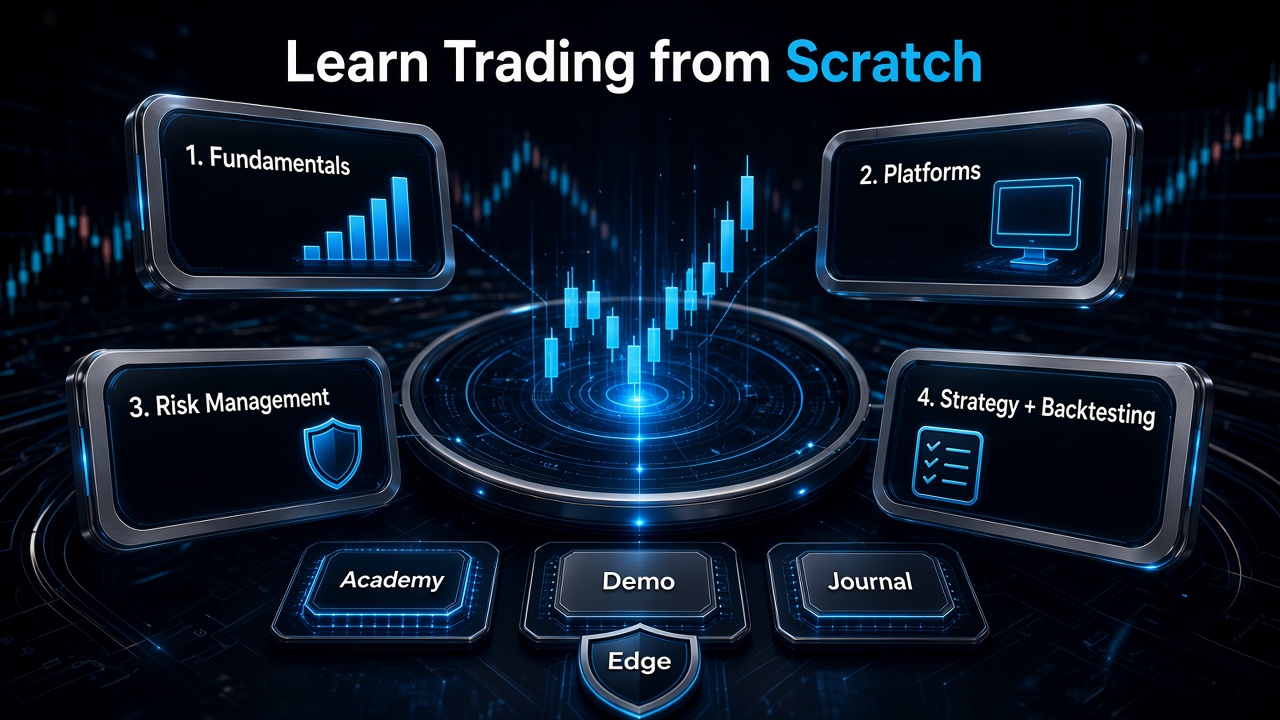
What should you learn first in trading?
Before looking for a Day Trading or Forex strategy, you need the basic mechanics of financial markets. Start with What is trading and how you can get started.
First, understand what you are trading. Forex, indices such as the S&P 500 or Nasdaq, gold, stocks, and crypto behave differently.
Then learn chart building blocks:
- Candlestick Charts;
- timeframes;
- High and Low;
- trend and range;
- support and resistance;
- Market Structure;
- volume and volatility.
The goal is not to memorize hundreds of terms, but to understand the price movement on the chart. See the chapter on charts and technical analysis with TradingView.
Learn how to use trading platforms
Theory is not enough if you cannot turn analysis into a trade.
A beginner should learn an analysis platform such as TradingView and an execution platform such as MetaTrader 5.
For execution you need Buy/Sell, Market and Pending Orders, Entry, Stop Loss, Take Profit, Position Size, and Lot Size.
Practice these in a Demo environment before real capital is at risk.
Risk Management before profit
One of the most common beginner mistakes is focusing only on profit: “How much can I make?”
The question that comes first is: “How much can I lose if my analysis is wrong?”
That is where Risk Management starts. Before every trade you need invalidation, risk size, and whether that loss is acceptable.
A Stop Loss is not a failure. It is the level where you accept that the trade idea is no longer valid. Without Risk Management, even a good strategy can become useless.
Understand Market Structure and Liquidity
After the basics, learn how price organizes itself.
Market Structure helps you identify trend, structure shifts, and the relationship between highs and lows.
Liquidity helps explain why certain chart areas attract price and why important moves often form around highs, lows, and other watched levels.
Concepts such as BOS, CHoCH, Liquidity Sweep, and Displacement make sense only after the fundamentals are clear.
When should you learn a trading strategy?
After markets, platforms, Market Structure, Liquidity, and Risk Management, a strategy has context.
A strategy should answer: when you look for a trade, what must happen before Entry, confirmations, Stop Loss, Take Profit, risk size, and when you do not trade.
A simple structure: Filters → Confirmations → Execution → Risk Management → Trade Management → Review.
For validation criteria, see What a profitable Day Trading strategy means.
How do you know if a trading strategy works?
Not after three winning trades, and not after a screenshot with a large profit.
Through Backtesting you apply the same rules to historical data and record every valid setup, including losses.
Then you can measure Win Rate, Average Win, Average Loss, Risk-to-Reward, Expectancy, Profit Factor, Maximum Drawdown, and losing streaks.
A 40% Win Rate strategy can still have positive Expectancy, while a 70% Win Rate strategy can lose money if average losses are much larger than wins.
Backtesting before real money
Backtesting lets you study a strategy without the pressure of a live position. Historical results are not enough.
Next comes Forward Testing in live conditions, first on a Demo Account. See how to backtest correctly.
Here appear hesitation, late entries, fear of loss, FOMO, ignoring Stop Loss, early exits, and Overtrading. You test both the strategy and your ability to execute it.
You need a Trading Journal
If you do not record what you do, it is hard to separate impressions from reality.
A Trading Journal helps you document each trade and check whether you followed the strategy: instrument, session, setup, Entry, Stop Loss, Take Profit, result in R, and execution quality.
With enough trades, the journal answers which session works best, which setup performs, where mistakes cluster, and whether losses come from the strategy or from execution.
Psychology cannot be separated from strategy
You can know the rules and still fail to follow them.
After two losses you may raise risk to recover. After a missed trade you may chase from FOMO. After wins you may accept weak setups.
These problems are not solved by a new indicator. See Risk Management and probabilities. Clear rules make it easier to see whether you executed the strategy or traded emotions.
How long does it take to learn trading?
There is no universal timeline. Platform basics can be learned relatively quickly. Consistent analysis, execution, and risk control take far more practice.
Promises such as “become a profitable trader in 30 days” should be viewed critically. The early goal is not fast money. It is building a process you can measure and repeat.
Can you learn trading for free?
Yes, there is a lot of free educational material. The problem is fragmentation: Market Structure in one video, Risk Management in another, a strategy on a forum, psychology in an article.
Each piece can help, but there is not always a progression between them. A well-built course teaches fundamentals before advanced concepts, and strategy after the student can understand it.
Where can you learn trading from scratch?
Options include free materials, YouTube, books, communities, mentoring, and structured trading courses.
Whatever you choose, check what you get before you pay. A beginner course should cover fundamentals before strategy, plus Risk Management, execution, Backtesting, and performance review.
If a strategy is presented as profitable, look for data: sample size, period, clear rules, losses included, Win Rate, R:R, Expectancy, and Drawdown. See also how to validate a profitable strategy.
Learn trading from scratch with Xcelerate Trade Academy
Xcelerate Trade Academy was built in this order.
Instead of starting with a setup you do not yet understand, the path starts with fundamentals and progresses toward full strategy analysis and execution.
The Academy includes 10 chapters, about 70 lessons, and roughly 27 hours and 30 minutes of educational material: markets, macro, TradingView, MetaTrader 5, Risk Management, psychology, Market Structure, Liquidity, technical analysis, strategy, Backtesting, and performance analysis.
You also learn the Xcelerate Trade strategy, a Day Trading methodology with clear filters, confirmations, and execution rules, analyzed on more than 1,000 trades and over 10 years of history.
These results are not a promise of future performance. The goal of testing is to measure statistical behavior and a possible edge on a relevant sample.
If you want to learn trading from scratch, explore the full curriculum in Xcelerate Trade Academy.
In trading, strategy matters. But before you can execute a strategy correctly, you need to understand the market you are trying to trade.
Frequently asked questions
How do you learn trading from scratch?
Start with market and chart fundamentals, then platforms (TradingView, MetaTrader 5), Risk Management, Market Structure, and Liquidity. Only then learn a strategy and validate it with Backtesting and Forward Testing on Demo.
Where should beginners learn trading?
Free materials help, but a structured course provides clear progression. Xcelerate Trade Academy covers fundamentals before strategy, with about 70 lessons and 27h30m of material.
Can you learn trading for free?
Yes, but free content is often fragmented. Without a logical order, it is hard to connect Risk Management, execution, and strategy testing.
When should I learn a Day Trading strategy?
After you understand markets, platforms, Market Structure, Liquidity, and Risk Management. Otherwise you copy entries without context. See also how to validate a profitable strategy.
Why is Backtesting important?
Three trades or a screenshot do not prove an edge. Backtesting measures Win Rate, R:R, Expectancy, and Drawdown on a large enough sample.
When you have a tested process and want capital beyond your own account, see how to get a funded trading account.