Profitable Day Trading Strategy: What It Means and How to Validate It
What makes a Day Trading strategy truly profitable? Learn how to measure an edge with Backtesting, Win Rate, Risk-to-Reward Ratio, Expectancy, and a large enough sample of trades.
Profitable Day Trading Strategy: What It Means and How to Validate It is a strategy playbook on Xcelerate Trade. Read the summary and overview to learn the setup logic, invalidation ideas, and access rules before unlocking premium chapters or scripts.
Strategy content is for education and structured practice. It is not personalized investment advice. Always define stop risk, position size, and market conditions that fit your plan.
Continue with related Indicators and Academy tracks when you need chart tools or foundational lessons. Pricing explains membership tiers and individual $XLR unlocks.
When lessons exist, progress through chapters and quizzes in order. When only premium blocks exist, connect a wallet that meets the listed access rule before reading gated material.
Duration: ~12m
Category: strategies
Overview
What a profitable Day Trading strategy means and how to validate it with Backtesting, Win Rate, R:R, Expectancy, and 500+ trades.
If you have searched for “profitable Day Trading strategy”, “profitable trading strategy”, or “profitable Forex strategy”, you have probably already seen dozens of methods that promise impressive results.
Some talk about an 80% or 90% win rate. Others show a handful of winning trades and use them as proof that the strategy works.
In reality, a profitable trading strategy cannot be judged from a few trades or from win rate alone.
A strategy can have a 70% win rate and still lose money. Another can win only 40% of trades and stay profitable over time.
The difference comes from the strategy’s statistical edge, and from how that edge is validated.
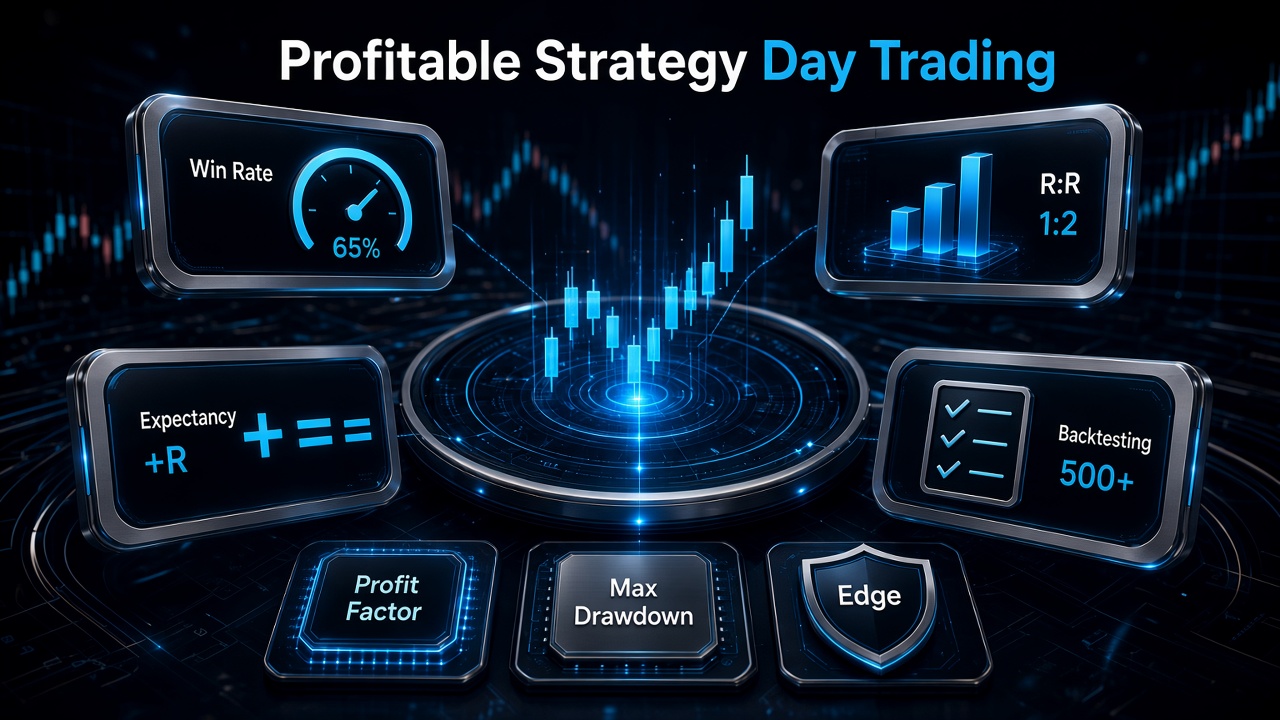
What does a profitable trading strategy mean?
In simple terms, a trading strategy is a set of rules that defines when you look for a trade, when you enter, where the idea is invalidated, and how you manage risk and profit.
A serious strategy should answer a few clear questions:
- What conditions must exist before Entry?
- What confirmations are required?
- Where is the Stop Loss placed?
- How is Take Profit set?
- How much capital is risked per trade?
- In which sessions and on which instruments is the strategy applied?
- In which situations do you not trade?
If these rules change after every loss or are interpreted differently from trade to trade, results become very hard to measure.
A profitable strategy does not mean a strategy that wins every trade. It means a strategy that, applied consistently over a large enough sample of trades, shows a positive statistical edge.
Win Rate alone does not tell you if a strategy is profitable
Win Rate is the percentage of winning trades out of all executed trades.
If you have 100 trades and 60 are winners, your Win Rate is 60%.
That sounds simple. The problem appears when Win Rate is analyzed without knowing how much you make when you are right and how much you lose when you are wrong.
Suppose a strategy has:
- Win Rate: 40%
- Average Win: +2R
- Average Loss: -1R
Over 10 trades, statistically, you might have about four winners and six losers.
The result would be: 4 × 2R = +8R; 6 × −1R = −6R; net: +2R.
The strategy loses more trades than it wins and still has a positive result.
Now take a strategy with a much more attractive Win Rate: Win Rate 70%, Average Win +0.5R, Average Loss −1.5R.
Over 10 trades: 7 × 0.5R = +3.5R; 3 × −1.5R = −4.5R; net: −1R.
70% of trades are winners, but the strategy loses money.
That is why the question “What Win Rate does the strategy have?” is not enough.
Risk-to-Reward Ratio: how much you risk for how much you can make
Risk-to-Reward Ratio, or R, compares the risk of a trade with its potential profit.
If you risk €100 for a potential profit of €200, the ratio is 1:2. If you risk €100 for €300, the ratio is 1:3.
A higher R does not automatically make a strategy better. The farther the target, the lower the probability that price reaches it can become.
That is why Win Rate and R must be analyzed together.
The strategy needs a balance between how often it wins and the average size of wins versus losses.
This is where one of the most important metrics comes in: Expectancy.
Expectancy: what the strategy produces on average per trade
Expectancy measures the average result the strategy can generate over the long term, based on its historical outcomes.
A simplified formula is: Expectancy = (Win Rate × Average Win) − (Loss Rate × Average Loss).
Example: Win Rate 40%, Average Win 2R, Loss Rate 60%, Average Loss 1R → (0.40 × 2R) − (0.60 × 1R) = +0.20R per trade.
That does not mean the next trade will produce +0.20R. Expectancy only becomes meaningful over a large sample of trades.
This is why professional trading is built around probabilities, not predicting the next candle.
Why Backtesting is essential
You can build a strategy that looks great on the chart. You can find ten perfect examples in the past. None of that yet proves the strategy has an edge.
For that, we need Backtesting.
Backtesting means applying the same rules to historical data and recording the result of every trade.
The goal is not to find only the examples where the setup worked. Every valid situation under the strategy rules must be recorded, including losses.
A well-built Backtest can track: Win Rate, Average Win, Average Loss, Risk-to-Reward Ratio, Expectancy, Profit Factor, Maximum Drawdown, number of trades, consecutive losing streaks, and performance across different periods.
The smaller the sample, the more results can be driven by random variation. 10, 20, or even 50 trades are not enough for solid conclusions.
Are 100 trades enough?
There is no universal number that automatically turns a Backtest into a valid result.
100 trades give more information than 20, but a strategy can still pass through favorable and unfavorable periods.
At Xcelerate Trade, published strategies are evaluated on a minimum of 500 trades. The goal is not a spectacular Win Rate for marketing, but observing how the strategy behaves on a sample large enough to analyze the relationship between Win Rate, R, Expectancy, and Drawdown.
A strategy must be tested in different market conditions
Another problem appears when a strategy is tested only in a period when the market favored it.
There are periods of strong trend, consolidation, high or low volatility, and macroeconomic shifts.
A Trend Following strategy can perform well in a directional market and poorly in a range. Mean Reversion can behave the opposite way.
For the Xcelerate Trade strategy, the testing process includes more than 1,000 trades and historical data covering more than 10 years of market activity.
This does not guarantee future results. It does show that the methodology is not evaluated only on a few selected setups.
What a Day Trading strategy must include
A complete strategy is not just an Entry. Entry is only one part of the process.
In a structured framework, the process can look like this:
- Filters → Confirmations → Execution → Risk Management → Trade Management → Review
Risk Management sets how much capital can be lost if the analysis is wrong. Trade Management defines how the position is handled after Entry. Review feeds the result into statistics.
Without these components, the trader risks making different decisions every time and later calling those decisions a “strategy”.
What is the most profitable Day Trading strategy?
There is no single strategy that is the most profitable in every market, on every instrument, and in every period.
Trend Following, Breakout, Mean Reversion, Liquidity Trading, Market Structure, Supply and Demand, or other methodologies can produce different results depending on how they are defined and the conditions in which they are applied.
When you see phrases like “most profitable trading strategy” or “Forex strategy with 90% Win Rate”, the first thing you should look for is not the Entry. Look for the data.
- How many trades were tested?
- Over what period?
- What are the Win Rate, Average Win, Average Loss, Expectancy, and Maximum Drawdown?
- Were all valid setups included, or only winning examples?
- Can the rules be applied the same way every time?
These questions say far more about a strategy than a screenshot with a few profitable trades.
A profitable strategy does not eliminate losses
Losses are part of trading. Even a strategy with positive Expectancy can have five, six, or more consecutive losses.
That is why Risk Management is inseparable from strategy.
If the trader risks too much on each position, a normal losing streak can create a Drawdown so large that the strategy’s statistical edge becomes irrelevant.
The goal is not to avoid every loss. The goal is that no single loss and no normal losing streak compromises the ability to keep executing the strategy.
Backtesting is not the final step
Historical results are the beginning of validation, not the end.
After Backtesting come Forward Testing and execution in a controlled environment, for example on a Demo Account. See the lesson on Backtesting.
Other variables appear: decision speed, Spread, Slippage, emotions, hesitation, and differences between theoretical and real execution.
Only after the strategy and execution process are understood well enough does a gradual move toward real capital or a Prop Firm make sense.
How to learn to build and apply a trading strategy
For someone starting from zero, a strategy cannot be understood in isolation. Before strategy you need markets, charts, Candlestick Charts, timeframes, Market Structure, Liquidity, Risk Management, platforms, and the psychology of your own decisions.
That is why Xcelerate Trade Academy is built progressively.
The program includes 10 chapters and about 70 lessons, with roughly 27 hours and 30 minutes of educational material. The path starts with trading fundamentals and continues with market analysis, TradingView, order execution, Risk Management, trader psychology, technical analysis, the Xcelerate Trade strategy, Backtesting, and performance analysis.
The Academy is built both for people who want to learn trading from scratch and for traders who already have experience but want to structure their process better.
Inside the Academy you also learn the Xcelerate Trade strategy, a Day Trading methodology built around a clear set of filters, confirmations, and execution rules. The strategy was analyzed on a sample of more than 1,000 trades and historical data covering more than 10 years.
If you want to learn trading from scratch and understand not only how a strategy is executed, but also why it works, how it is tested, and how you measure its performance, you can start with Xcelerate Trade Academy.
Frequently asked questions
What is the most profitable Day Trading strategy?
There is no single strategy that is the most profitable in all market conditions. A strategy must be evaluated through results on a large enough sample, using metrics such as Win Rate, Average Win, Average Loss, Risk-to-Reward Ratio, Expectancy, and Maximum Drawdown.
What Win Rate does a profitable strategy need?
There is no universal minimum Win Rate. A strategy with a 40% Win Rate can be profitable if Average Win is large enough relative to Average Loss. At the same time, a strategy with a 70% Win Rate can have negative Expectancy.
How many trades are needed for Backtesting?
There is no number that guarantees a strategy is valid. In general, a larger sample gives more relevant information about strategy behavior. Xcelerate Trade uses a minimum of 500 trades for published strategy statistics.
Can a Forex strategy be profitable long term?
It can show positive Expectancy on historical data and in certain market conditions, but past results do not guarantee future performance. The strategy must be monitored and reassessed as new data accumulates.
Can I learn Day Trading from scratch?
Yes, but strategy should not be the first thing you learn. You need markets, platforms, Market Structure, Risk Management, execution, and the analysis process before applying a complete strategy. With Xcelerate Trade Academy you learn everything from scratch and everything you need to become a profitable, professional trader.