What Is Trading? What Trading Means and How It Works
What is trading and how does it work? Learn Buy, Sell, Day Trading, Forex, Stop Loss, Risk Management, and how to start from scratch.
What Is Trading? What Trading Means and How It Works is a strategy playbook on Xcelerate Trade. Read the summary and overview to learn the setup logic, invalidation ideas, and access rules before unlocking premium chapters or scripts.
Strategy content is for education and structured practice. It is not personalized investment advice. Always define stop risk, position size, and market conditions that fit your plan.
Continue with related Indicators and Academy tracks when you need chart tools or foundational lessons. Pricing explains membership tiers and individual $XLR unlocks.
When lessons exist, progress through chapters and quizzes in order. When only premium blocks exist, connect a wallet that meets the listed access rule before reading gated material.
Duration: ~16m
Category: strategies
Overview
What trading means: markets, Buy/Sell, Day Trading, analysis, Risk Management, and the path from zero.
Trading means buying and selling financial instruments to benefit from price moves.
You can trade stocks, Forex, indices, gold and other commodities, crypto, and more.
The basic idea sounds simple: if you correctly anticipate direction, you can profit. In reality, trading is much more than choosing Buy or Sell.
A trader must understand the market, work with probabilities, control risk, and run a repeatable process without knowing the next price move with certainty. See also What is trading and how you can get started.
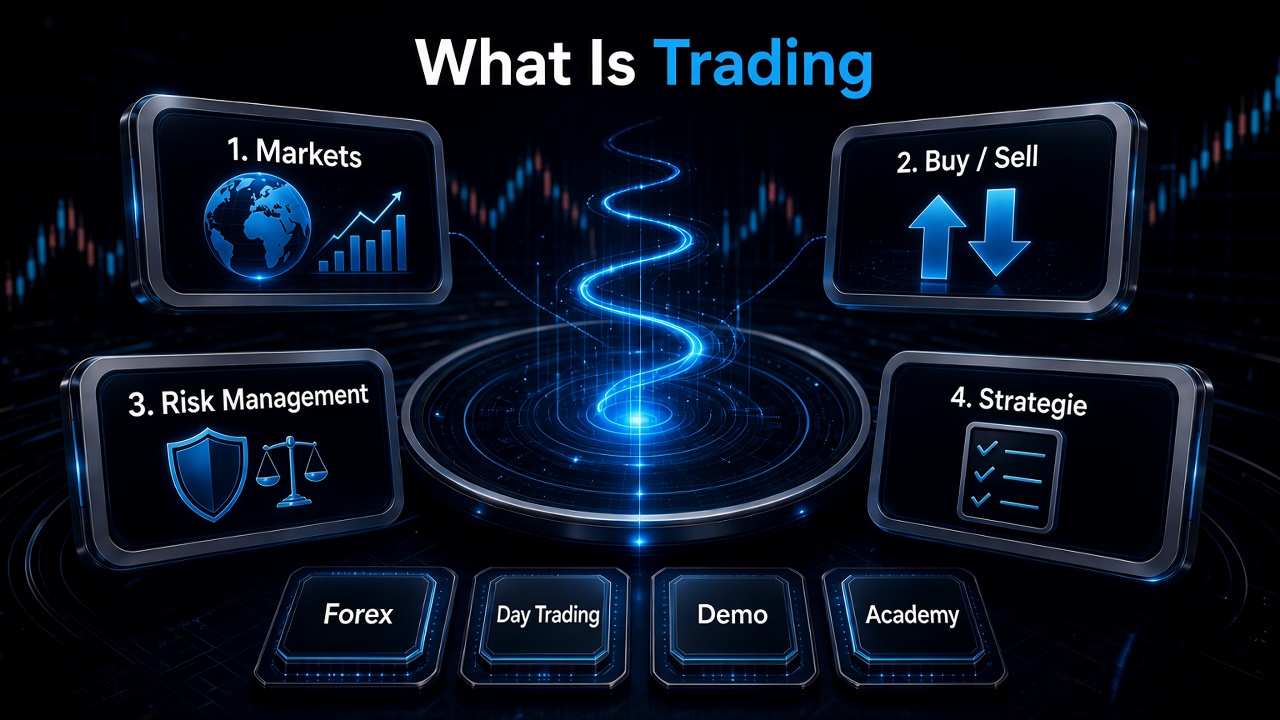
What does trading mean?
In financial markets, trading is the process of buying or selling an instrument to benefit from a change in its price.
If a trader expects gold is more likely to rise, they may open Buy. If price rises, the position can profit; if it falls, it can lose. In many markets you can also Sell (short) when a decline looks more probable.
So trading is not only “buy low, sell high” — depending on the instrument, traders may try to benefit from both rising and falling prices.
Which markets can you trade?
Forex (currency pairs such as EUR/USD), indices (S&P 500, Nasdaq 100, Dow, DAX), stocks, commodities (gold, oil, silver), and crypto (Bitcoin, Ethereum — often 24/7 with higher volatility).
How does trading work?
Simplified: analyse context (bullish/bearish?), key levels, liquidity, strategy setup, invalidation, and risk. If rules are met, open a trade with Entry, Stop Loss, Take Profit, Position Size, and R:R.
Professional trading starts with risk and invalidation — not “how much can I make?”
What do Buy and Sell mean?
Buy/Long seeks a rising price. Sell/Short seeks a falling price when shorting is available. Example: instrument at 5,000 — Long benefits if price goes to 5,050; Short benefits if it goes to 4,950. Outcomes also depend on size, costs, and execution.
What is Day Trading?
Day Trading generally opens and closes positions the same session. You care about today’s setups (e.g. indices, gold, Forex in London/New York) — and not trading when no setup appears can be the right decision.
Trading vs investing
Investors usually hold for years. Traders focus on shorter moves (minutes to weeks). Neither is automatically “better” — goals, horizons, and risk profiles differ.
What is technical analysis?
Technical analysis studies price behaviour on the chart: Market Structure, highs/lows, support/resistance, Liquidity, volume, volatility, trends, patterns, indicators. The goal is not certainty — it is finding contexts with enough probability to execute a strategy.
What is fundamental analysis?
Fundamentals look at economic drivers: inflation, rates, monetary policy, labour data, growth, central banks. Events like CPI, NFP, or FOMC can change volatility and liquidity. You may not build every Entry from macro, but you should know when conditions can shift hard.
What is Risk Management?
Risk Management defines how much you can lose if the idea is wrong — before Entry. Example: $10,000 account, 1% risk → $100 planned risk; Position Size follows Stop Distance.
What is a Stop Loss?
A Stop Loss closes a position at a predefined level — ideally where the trade idea is invalidated. Without a clear risk limit, a small loss can become a large one.
What is Take Profit?
Take Profit is where you plan to close a winning trade (full or partial). Risk-to-Reward of 1:2 means planned profit is twice planned risk — not a guarantee of winning.
Can you make money from trading?
Yes — but not easily and never guaranteed. What matters is positive Expectancy over a large sample after costs (Win Rate, Average Win/Loss, R:R, Profit Factor, Drawdown). See Profitable Day Trading Strategy.
Is trading gambling?
It can resemble gambling without strategy and risk control. A structured approach uses rules, testing, journaling, and statistics. You cannot control the next trade’s outcome — you can control setups, risk, and process.
Do you need a trading strategy?
For a repeatable process: yes. Filters → Confirmations → Execution → Risk Management → Trade Management → Review. See how to learn trading from scratch.
How do you know if a strategy works?
With data. Backtesting applies the same rules on history and logs every valid setup — not only winners. It does not guarantee the future, but beats cherry-picked screenshots.
How much money do you need?
There is no universal amount. Learn platforms, Backtest, and practise on Demo before risking meaningful capital. Prop / funded accounts exist, but funding does not replace education or risk control.
Is trading suitable for beginners?
You can learn from zero — but do not start with large financial risk. Order: Fundamentals → Platforms → Risk → Structure → Liquidity → Strategy → Backtesting → Forward Testing → Demo → Controlled execution → Review.
How to start learning trading from scratch
Do not chase the “perfect trade” first. Understand markets, then risk and platforms, then structure and liquidity, then a full strategy and data. Guide: How and Where to Learn Trading from Scratch.
Learn trading from scratch with Xcelerate Trade Academy
Xcelerate Trade Academy follows that progression (~10 chapters, ~70 lessons, ~27h30m), including the Xcelerate Trade Day Trading methodology analysed on 1,000+ trades and 10+ years of data. Past performance does not guarantee future results.
Trading is not knowing what the market will do every time — it is having a process when you cannot know for sure.