Where to Learn Trading? Learn How to Trade
Want to learn trading but don’t know where to start? Learn how to choose educational sources, spot unserious courses, and where you can learn to trade.
Where to Learn Trading? Learn How to Trade is a strategy playbook on Xcelerate Trade. Read the summary and overview to learn the setup logic, invalidation ideas, and access rules before unlocking premium chapters or scripts.
Strategy content is for education and structured practice. It is not personalized investment advice. Always define stop risk, position size, and market conditions that fit your plan.
Continue with related Indicators and Academy tracks when you need chart tools or foundational lessons. Pricing explains membership tiers and individual unlocks.
When lessons exist, progress through chapters and quizzes in order. When only premium blocks exist, connect a wallet that meets the listed access rule before reading gated material.
Duration: ~14m
Category: strategies
Overview
Where to learn trading: free resources vs courses, red flags, and how to start with Xcelerate Trade Academy.
If you want to learn trading, you have probably already noticed how much information exists online. You will find thousands of YouTube videos, TikTok strategies, Telegram groups, online courses, and people who promise to turn you into a profitable trader in just a few weeks.
But where should you start? How do you choose the right information? Is it worth paying for a trading course, or can you learn for free? And most of all, how do you tell a credible educator from someone who mainly makes money selling courses and signals?
The real challenge is not finding trading information — it is identifying trustworthy sources and learning in an organized way.
In this article we look at where you can learn trading, how to choose a suitable course, which red flags to recognize, and how to start studying financial markets without falling for get-rich-quick promises.
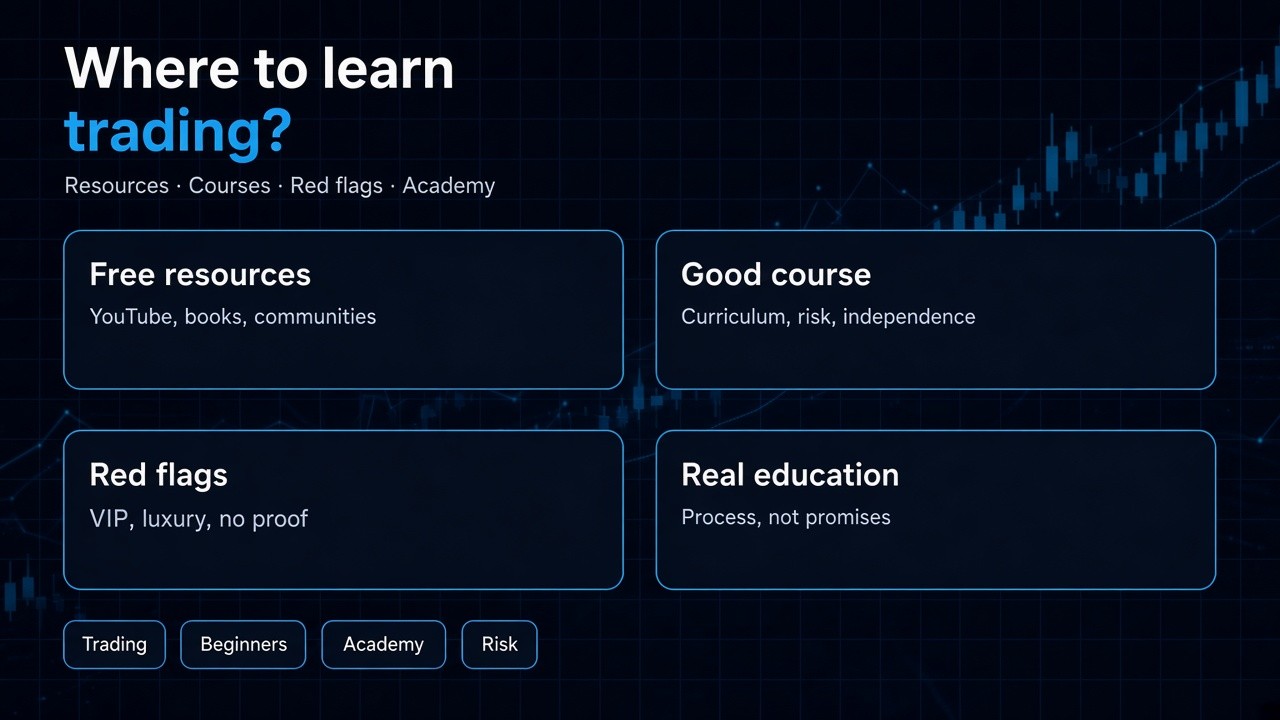
Where can you learn trading?
There are several ways to start learning trading, each with advantages and limits.
1. YouTube and free educational resources
YouTube can be a starting point for concepts such as Forex, Day Trading, technical analysis, or Risk Management.
You can find explanations about charts, trading platforms, and strategies without paying for every lesson.
Still, you must select sources carefully. Not everyone who posts winning trades can explain a strategy or show that it works over the long term.
A video with three winning trades is not proof of profitability.
Another issue is the lack of clear structure. You may watch Market Structure today, Fair Value Gap tomorrow, and an indicator strategy the day after — without understanding how the ideas connect.
Free resources can be valuable, but study in a logical order and cross-check information from multiple sources.
2. Books on trading and trader psychology
Books help build a theoretical base and understand the psychological side of trading. Well-known titles include:
- Trading in the Zone, by Mark Douglas — probabilities, discipline, and trader psychology.
- The Disciplined Trader, by Mark Douglas — behavior and emotional decisions.
- Technical Analysis of the Financial Markets, by John J. Murphy — core technical analysis concepts.
These books can complement your education, but reading alone will not teach you to execute a strategy and manage positions in live market conditions.
You can understand theory well and still struggle when you must decide on a live chart.
That is why study should be completed with practical analysis, Backtesting, and reviewing results.
3. Trading communities
Communities on Reddit, Discord, or Telegram can offer discussion with others interested in financial markets.
You can discover different perspectives, ask questions, and compare approaches.
Still, distinguish an educational community from a group built only around trading signals.
If you get a message like “BUY GOLD NOW” without understanding the analysis, invalidation level, or risk, you are not learning to trade — you are copying someone else’s decision.
A useful community should encourage discussion about strategies, mistakes, Risk Management, and results — not dependence on an admin’s tips.
4. Trading courses and academies
A structured course can help if you do not want to spend months organizing information from scattered sources.
The advantage is that lessons can follow a logical order, with advanced concepts introduced after fundamentals.
For example, before studying a strategy based on Market Structure and Liquidity, you should understand how markets work, how to read charts, and how to manage risk.
But not all courses are equal.
Before you pay, review the curriculum, practical examples, strategy rules, and how risks are explained.
A good course should help you become independent in decision-making — not force you to keep buying signals or add-on subscriptions.
How do you choose a good trading course?
A high price does not guarantee educational quality.
A course that costs several thousand euros is not automatically better than an affordable — or even free — program.
Before you enroll, try to learn what you will actually study.
Is there a clear curriculum? Are beginner concepts explained? Do you get practical examples? Are losing trades shown too? Does the strategy have rules you can test?
A serious educational program should give real attention to risk management, trader psychology, and performance evaluation.
Also check whether the materials teach you to analyze the market independently or only to mechanically copy presented trades.
Trading is not memorizing a few chart patterns. It is understanding context, applying rules, and managing uncertainty.
Be cautious with guaranteed-profit promises, claims of safe daily gains, or strategies presented as infallible.
No course can guarantee that every student will become profitable.
Watch out for fake traders on TikTok, Instagram, and YouTube
If you searched for trading content on TikTok, Instagram, or YouTube, you have likely seen people presenting themselves as successful traders — luxury cars, expensive watches, exotic vacations, and spectacular profit screenshots.
Behind those images there is often an offer: a trading course, VIP group access, Buy and Sell signals, or a monthly subscription that promises you can make money by following someone else’s trades.
The problem is that lifestyle display is not proof of profitability.
Someone can earn significant income selling courses, subscriptions, trading signals, or promoting brokers without necessarily being profitable from their own trading.
Some people build their entire image around financial success but do not show a verifiable trade history, long-term results, or clear evidence that displayed income comes from trading.
A screenshot of a €10,000 profit does not prove that trader is profitable. It does not show prior losses, risk taken, capital used, or overall account results.
How do you recognize a possible seller of illusions?
Be especially careful when you see these red flags:
- Promises you can make hundreds or thousands of euros daily with no experience.
- Constantly uses luxury cars, watches, and vacations to promote courses.
- Sells trading signals or VIP group access but does not explain the strategy and risks.
- Publishes only winning trades and never shows losses.
- Makes unverifiable performance claims: no complete verifiable track record, only winners shown with no losses/drawdown, or “guaranteed” / “every day” profit promises.
- Pressures you to buy a course or subscription quickly.
- Promotes brokers via affiliate links without clearly explaining how they are paid.
- Cannot transparently explain how the strategy’s results are calculated.
These behaviors do not automatically prove someone is a scammer or losing money trading, but they are serious reasons to verify information before you pay.
How does a trading educator make money?
It is important to separate income from trading markets from income from commercial activities.
A content creator can earn from courses, private communities, signal subscriptions, advertising, and broker partnerships.
There is nothing wrong with being paid for quality education. The problem appears when someone uses supposed trading profitability to sell educational products without being able to support the claims.
Before you buy a course, ask yourself: is this person teaching me to understand and trade independently, or trying to convince me to keep paying forever for their signals and recommendations?
A credible educator should also explain losing trades, strategy limits, risks, and the importance of testing.
Don’t buy promises. Invest in education.
If you want to become a trader, your goal should not be copying trades from someone on Instagram or Telegram.
You should learn how markets work, how to identify opportunities, how to manage risk, and how to check whether a strategy has a statistical edge.
A trading course should not sell you the image of a luxury lifestyle — it should give you knowledge, explanations, and tools you can use independently.
So before paying hundreds or thousands of euros for a course promoted on social media, compare available educational alternatives too.
Learn to trade with Xcelerate Trade Academy
If you are looking for a structured trading course, you can explore Xcelerate Trade Academy.
The program is designed for people who want to understand financial markets — from first concepts through technical analysis, risk management, and applying a Day Trading strategy.
The Academy is organized into 10 chapters, with about 70 lessons and 27 hours and 30 minutes of educational material.
It covers trading platforms, trader psychology, Market Structure, Liquidity, technical analysis, Risk Management, and performance evaluation.
The program also includes the Xcelerate Trade strategy, analyzed on more than 1,000 historical trades and market data covering more than ten years. Historical testing does not guarantee future performance.
The Academy’s goal is to help you understand the logic behind trades and develop your own process — not to depend on Buy and Sell signals.
If you want to learn trading from scratch, in a logical order, you can review the curriculum and lessons on the Academy page.
Discover Xcelerate Trade Academy and start learning how to trade.
Can you learn trading without a mentor?
Yes. Some traders study individually using books, educational materials, charts, and testing platforms.
A mentor or structured program can help organize the process, but it cannot replace personal practice.
Whatever method you choose, you will still need to identify mistakes, manage risk, and evaluate your performance.
An advantage of self-study is flexibility. You can progress at your own pace and explore more perspectives.
On the other hand, lack of structure can lead to confusion, constantly switching strategies, and difficulty measuring progress.
What matters is not confusing accumulating information with developing practical skills.
You can watch hundreds of hours of trading videos without having a strategy you can execute consistently.
How much should you pay to learn trading?
There is no mandatory amount.
You can start with free materials and later decide whether a paid course offers enough extra value.
Do not spend money needed for essential expenses on courses, and do not assume a multi-thousand-euro program automatically gives you better odds of success.
Compare content, transparency, educational support, and total cost before deciding.
If a course promises you will recover your investment in a few days of trading, that is another reason for caution.
Education can help you build skills, but it is not a guarantee that you will earn income from financial markets.
Frequently asked questions
Where should I learn trading?
You can use books, online resources, communities, and structured courses. One structured option is Xcelerate Trade Academy, which includes lessons from beginner level through advanced concepts.
Can I learn trading for free?
Yes. There are many free resources. What matters is checking information quality and not confusing promotional material with education.
Is buying a trading course worth it?
It depends on content, price, and your needs. A course can save time and organize learning, but it does not guarantee profitability.
How do I trade from scratch?
Start by studying financial markets, chart analysis, and Risk Management. Then learn a strategy, test it, and practice on Demo. For a detailed path, read our guide Learn Trading from Scratch.
How do you become a successful trader?
Through education, practice, risk management, a strategy with verifiable rules, and constant evaluation of results. There is no timeline or method that guarantees profitability.
Are VIP trading signal groups credible?
Not all groups are the same, but signal subscriptions should be verified carefully. Check result transparency, risks, commercial terms, and possible conflicts of interest. Copying signals does not replace education.
How do I verify if a trader is profitable?
Look for a sufficiently long history, complete and verifiable results, and information about Drawdown, risk, and costs. Individual profit screenshots are not enough. Even a real profitable history does not guarantee future results.
Are there trading courses in English?
Yes. There are English-language resources and programs, including Xcelerate Trade Academy, which offers a path from fundamentals to strategies and practical analysis.
Choose education, not promises
If you want to learn how to trade, do not start by looking for whoever promises the biggest gains or displays the most luxurious lifestyle.
Look for clear explanations, strategies that can be tested, and resources that help you understand trading decisions yourself.
You can start for free, learn individually, or follow a structured program such as Xcelerate Trade Academy.
What matters is choosing an educational process you understand, developing your analytical ability, and not confusing finishing a course with becoming profitable.
Trading takes time, discipline, and practice. There are no shortcuts that remove risk, and education should prepare you for market reality — not sell you a promise of quick gains.